
"Every event-responsive system inevitably reflects the essential structure and invariants of the system in which it is embedded."
If you’ve ever picked up a popular science book on quantum mechanics, you were likely sold a story about a universe that rolls dice.
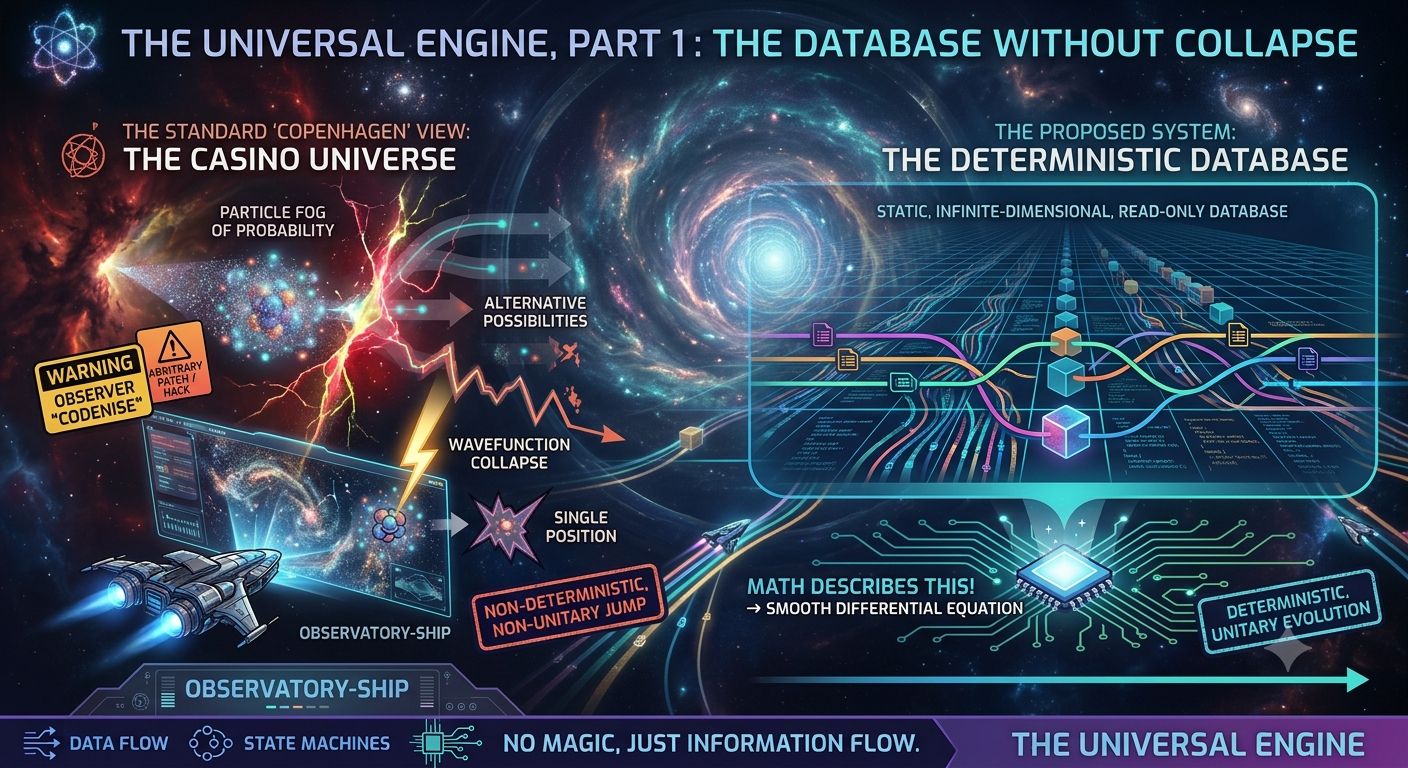
You were told that particles exist in a ghostly fog of "probability" until a conscious human observer looks at them, at which point reality magically snaps its fingers, destroys all alternative possibilities, and forces the particle to pick a single position. In textbook physics, this sudden, non-unitary jump is called Wavefunction Collapse.
If that sounds like an ad-hoc hack added late in a release cycle to force a buggy system to compile... you aren't alone.
To anyone accustomed to low-level systems architecture, state machines, and information flow, the standard Copenhagen interpretation of physics feels less like a fundamental law of nature and more like a patch job. It introduces an arbitrary, non-deterministic exception to an otherwise smooth, deterministic differential equation.
What if we threw out the patch?
What if we stopped treating the universe like a magical casino and started treating it like what the math actually describes: a massive, static, infinite-dimensional, read-only database?
1. The Monolithic State Vector
In 1957, Hugh Everett III proposed something radically simple: the wavefunction never collapses.
There are no cosmic dice rolls. There is no magical threshold where quantum rules stop and classical rules begin. There is only one equation—Schrödinger’s equation—and it applies to everything, everywhere, all the time.
In computer science terms, Everett proposed that the entire cosmos is defined by a single, global state vector:
$$|\Psi_{\text{universe}}\rangle$$
State transitions in this vector are governed entirely by deterministic, information-conserving unitary operators:
$$\hat{U}(t_2, t_1)=e^{-\frac{i}{\hbar} \hat{H} (t_2 - t_1)}$$
$$|\Psi(t_2)\rangle=\hat{U}(t_2, t_1) |\Psi(t_1)\rangle$$
Because $\hat{U}$ is unitary ($\hat{U}^\dagger \hat{U}=I$), state evolution is completely reversible and information is strictly conserved. This is a pure-function pipeline ($f(x) \rightarrow y$). There are no side effects, no dropped bits, and no non-deterministic state mutations.
The global state vector doesn't "update" in real-time based on local events. It doesn't drop historical branches, and it certainly doesn't delete data. It is a complete, immutable, deterministic manifold containing every state, every correlation, and every possible configuration of matter and energy.
It is the raw, un-truncated database running on the bare metal of reality.
2. Quantum Entanglement as a JOIN Operation
If the global database is completely deterministic and contains all possible outcomes, why does your day-to-day life feel so relentlessly classical, linear, and probabilistic? Why don't you see Schrödinger's cat sitting in a superposition of alive and dead on your kitchen counter?
Because you are not the server. You are a client.
When you perform an experiment—or simply open your eyes and interact with an environment—your local physical hardware (your brain, your sensors, your measuring devices) becomes entangled with the system you are observing.
Before interaction, the target system and the observer exist in a tensor product state:
$$|\Psi_{\text{system}}\rangle \otimes |\Phi_{\text{observer}}\rangle=\left( \alpha |0\rangle + \beta |1\rangle \right) \otimes |\text{Ready}\rangle$$
When measurement occurs, the interaction Hamiltonian forces an entanglement operation. You don't "collapse" the system; you execute a unitary JOIN:
$$|\Psi_{\text{joint}}\rangle=\alpha |0\rangle \otimes |\text{Observed 0}\rangle + \beta |1\rangle \otimes |\text{Observed 1}\rangle$$
Your local state becomes correlated with a specific subset of the global state vector. You haven't destroyed the alternate rows in the database; your local client memory primary key simply now maps to one specific relational row.
3. The Client-Side Rendering Illusion
Why does the observer experience a single, classical outcome if both branches still exist in the database?
Once a client system entangles with a target, environmental interactions (photons, thermal fluctuations) rapidly lock the relative phase between terms. In quantum mechanics, this is Decoherence. In systems engineering, it is isolation between memory segments.
Because the observer's own memory state vector is bound inside a specific branch of the join, the local execution thread lacks the memory pointers required to cross-inspect adjacent branches. The terminal isn't viewing a "collapsed" universe; its internal state register simply has no address space mapped to the peer thread.
Edited on Jul 30, 2026 By intenseC .